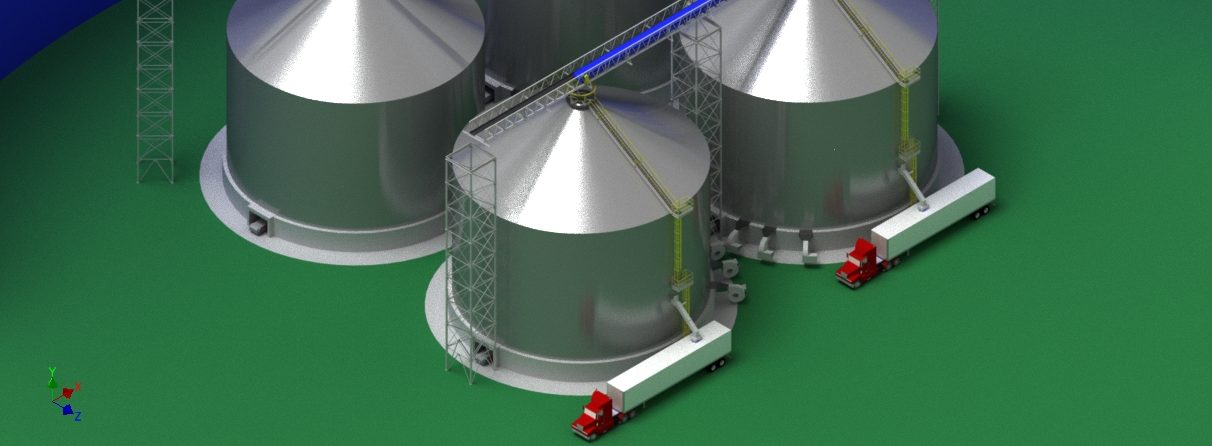
Why 3D Plant Design Matters
Modern grain handling, feed manufacturing, and seed processing facilities are complex systems that combine mechanical equipment, structures, utilities, and process flow into a single operating plant. Effective facility design requires clear communication between engineers, equipment suppliers, contractors, and plant operators.
For decades, most industrial facilities were designed using two-dimensional engineering drawings. While these drawings remain necessary for construction, they can be difficult for many stakeholders to interpret.
Three-dimensional plant modeling provides a much clearer way to communicate how a facility will actually be built and operated.
Process Equipment & Design LLC develops detailed 3D plant models that allow clients to see and understand their facility long before construction begins.
3D Models Communicate the Design
Engineering drawings are a form of communication. However, many stakeholders involved in a project — including plant managers, company executives, and investors — are not trained to read technical 2D drawings.
A detailed three-dimensional model allows the entire facility to be viewed in a way that is intuitive and easy to understand.
With a 3D model, stakeholders can clearly see:
- Equipment placement
- Conveyor routing
- Structural relationships
- Maintenance access
- Truck and rail loading areas
- Overall plant layout
Even individuals with no engineering background can quickly understand how the facility will function.
Identify Problems Before Construction
One of the greatest advantages of 3D plant modeling is the ability to identify potential problems before construction begins.
In traditional 2D design processes, conflicts between equipment, structures, and utilities are often discovered only after construction has started, resulting in costly changes and delays.
Three-dimensional models allow these conflicts to be identified early in the design phase, helping avoid:
- equipment interference
- conveyor routing conflicts
- inadequate maintenance access
- structural clearance issues
Resolving these issues during design saves time, reduces cost, and improves the final facility layout.
Improved Planning and Project Development
Three-dimensional facility models are also extremely valuable during project planning.
They allow project stakeholders to evaluate:
- alternative equipment layouts
- future plant expansion possibilities
- equipment access for maintenance
- operational flow through the facility
Because the model represents the complete facility, it becomes a powerful tool for discussing design options and making informed decisions during project development.
Support for Modern BIM Workflows
Three-dimensional plant modeling also aligns well with modern Building Information Modeling (BIM) workflows used by many architects, structural engineers, and construction teams.
A well-developed 3D facility model can be used to support:
- coordination with structural engineering models
- integration with architectural building models
- improved contractor understanding of the project
- clearer communication between all members of the project team
This collaborative approach helps improve coordination throughout the design and construction process.
A Practical Engineering Tool
For Process Equipment & Design LLC, 3D modeling is not simply a visualization tool. It is a practical engineering method used to develop efficient and buildable plant layouts.
Three-dimensional plant models allow detailed evaluation of:
- equipment elevations
- conveyor slopes and routing
- bin spacing and access
- structural integration
- maintenance clearances
This results in facility designs that are both easier to construct and easier to operate.
Helping Clients See the Facility Before It Exists
One of the most valuable aspects of 3D plant modeling is that clients can effectively walk through their facility before it is built.
This allows plant owners and operators to fully understand the design, provide feedback, and make adjustments during the design phase — when changes are still easy to implement.
By the time construction begins, the facility layout has already been thoroughly evaluated and refined.
Project Inquiries
For project inquiries please contact:
Dwight E. Kinzer
Process Equipment & Design LLC
Email: dwight@grainfeedseed.com
Phone: (620) 951-4211